

Luxating patella in dogs: the slipping kneecap, and when to operate
When a small dog skips a step or holds a back leg up for a stride, a kneecap slipping out of its groove is one of the most likely reasons. We grade it by feel, X-ray the knees and the hips, and operate here when the grade calls for it, and this page explains each of those steps.
Book an appointment →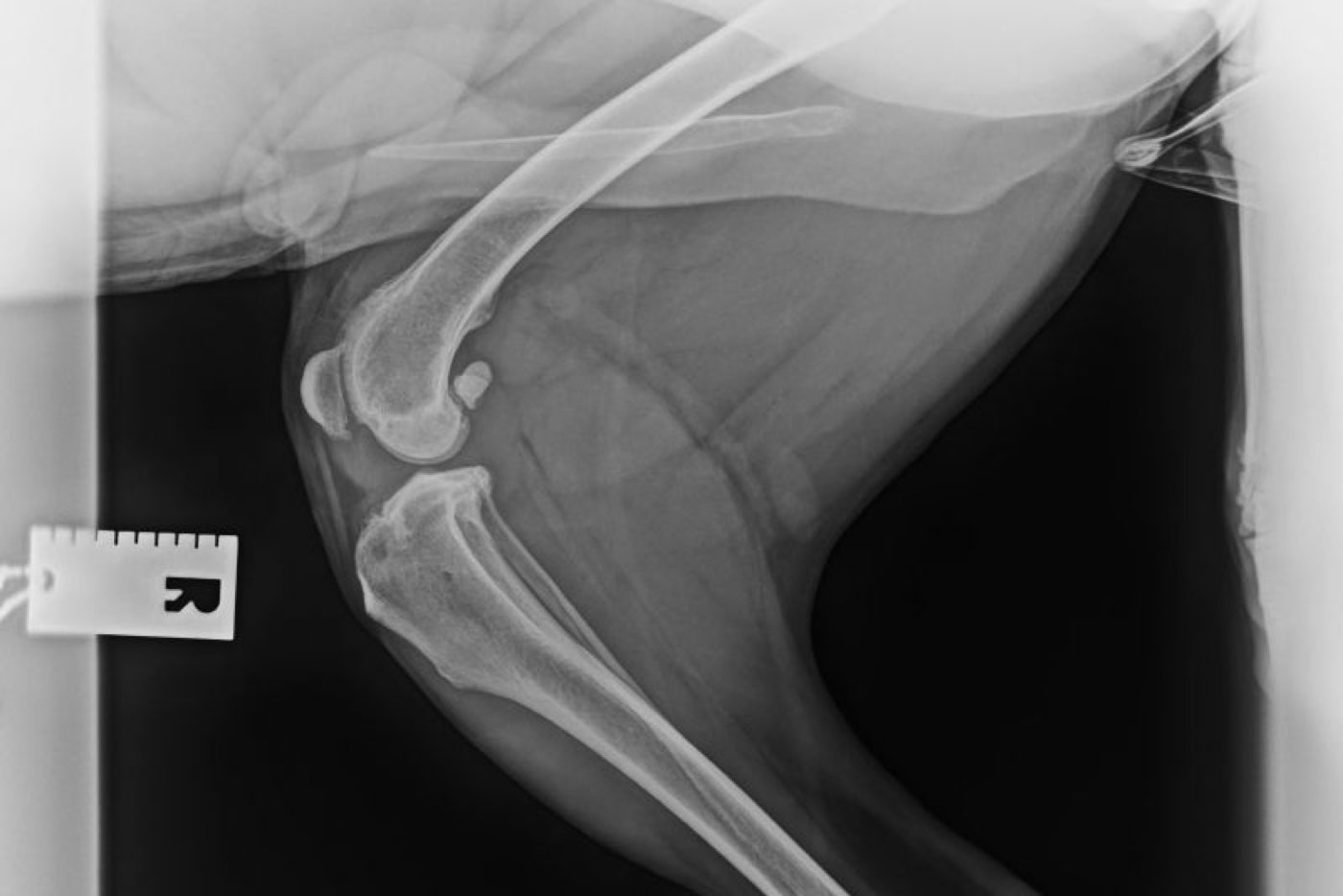
The short answer
We grade the knee by feel, X-ray it, and operate here when the grade calls for it.
A luxating patella is a kneecap that slips out of its groove. It is common in small breeds, it develops as the dog grows rather than being there at birth, and it often starts out painless, which is what makes it easy to live alongside without noticing. Left alone it rubs the joint and can lead to arthritis, although most dogs are managed comfortably without surgery. If we can feel the knee early, you will know the grade and you will have a choice rather than a decision made for you. If surgery is the right answer for your dog, patella surgery here is a fixed $4,000.
What is a luxating patella?
The kneecap should sit and slide in a groove at the end of the thigh bone. In a dog with a luxating patella it does not stay there. It slips out, and often pops back in on its own.
At first this is usually painless, and that is the whole reason this page exists. A dog who skips and then trots happily on is not necessarily telling you the joint is fine, and it may be telling you only that it does not hurt yet.
What happens next is friction. The kneecap rubs the surfaces of the joint every time it goes out and comes back, and that rubbing leads to arthritis. In some dogs the kneecap eventually stays out of the groove for good.
Why does it happen, and did I cause it?
No, you did not, and this is a question we are asked almost every time. This is simply how the leg grew.
It is a developmental problem, so a puppy is born with a normal-looking knee and it appears as the leg forms. Both breeding and environment can play a part, and neither of them is anything you could have managed differently at home.
Ultimately, a luxating patella develops because the quads, the big muscles at the front of the thigh, don't track properly while the dog is growing. When those muscles don't pull perfectly straight, the kneecap ends up out of alignment.
The groove itself is usually part of it too. In affected small-breed dogs the groove at the end of the thigh bone is nearly always too shallow or the wrong shape. This is a shape problem, not an injury, which is why surgery for it is about reshaping the joint rather than mending a tear.
Which dogs get it?
Small ones, overwhelmingly. A little over one dog in a hundred is diagnosed with it, and eleven breeds carry higher odds than crossbreds.
The four highest are:
- Pomeranian
- Chihuahua
- Yorkshire Terrier
- French Bulldog
The typical patient weighs around 8kg and is diagnosed at about four years old. Dogs who are lighter than average for their breed are slightly more likely to be diagnosed, so this is not a condition of overweight dogs and it is not something anyone has fed their way into.
They are the same much-loved breeds we see every week across Lane Cove, Macquarie Park and Eastwood, so this is very familiar ground for us.
What are the signs I should look for?
- The skip. A stride or two on three legs, then straight back to normal, often mid-run
- A back leg held up briefly, sometimes with a little shake before it goes down again
- A kick backwards, as though your dog may be trying to click something back into place, which is roughly what they are doing
- Stiffness after a rest, or reluctance to jump up where they used to
- Bow-legged stance behind, or sitting oddly with a leg out
- An audible click from the knee
A back-leg limp has several common causes and they do need telling apart, particularly from a torn cruciate, which is the other big one.
When we would rather see the knee promptly
- Your dog can be holding the leg up for more than a moment, or will not put weight on it
- The skipping is getting more frequent, or is happening on both back legs
- Your dog cries out when it happens, or would rather the knee was not touched
- The knee is hot or swollen
- Your dog has stopped jumping onto the furniture or into the car, when they used to manage it easily
A slipping kneecap is rarely an emergency, although a dog who suddenly cannot use a back leg does need seeing that day. Please give us a ring on 02 8552 7800 and describe what you are seeing, and we will let you know how quickly we would like to look at it.
How is it diagnosed, and what is a grade?
Mostly with our hands. We can feel the kneecap move out of its groove and back into it, and we can tell whether it goes out easily, whether it stays out, and whether it can be put back. We can usually grade it by feel in a dog who is wide awake and quite comfortable, which is one of the reasons it is a lovely thing to raise at a routine visit rather than saving it up.
An appointment covers:
- An orthopaedic examination of both knees and the rest of both back legs.
- X-rays of the knee.
- The hips as well, because a fair proportion of these dogs also have some degree of hip dysplasia.
The four grades, and what each means for your dog
We put a grade on the knee, from one to four. The grade is what most of the treatment conversation turns on, and we will always tell you which grade your dog has.
| Grade | What the kneecap does | Does it need surgery? |
|---|---|---|
| Grade 1 | Only slips out very occasionally, or when a vet manipulates it. | Never. |
| Grade 2 | Slips out on its own, but mostly sits in the groove. | If your dog is showing signs such as skipping, we tend to recommend surgery. If not, we don't operate. |
| Grade 3 | Spends a lot of time out of the groove, but can still go back in. | We always recommend surgery. |
| Grade 4 | Can't sit in the groove at all, and is permanently dislocated. | We always recommend surgery. |
Has your dog started skipping?
One appointment will tell you whether that kneecap is slipping, which grade it is, and whether it needs anything doing about it now. Often the answer is reassuring.
Does my dog need surgery?
It comes down to the grade, as the table above sets out, and many do not. Across a large group of newly diagnosed dogs, close to four in ten were managed without an operation, and around one in eight had surgery.
None of that is a prediction for your own dog. What it does show is that a diagnosis of luxating patella is not an automatic trip to theatre, which is usually the first thing owners worry about when they hear the words.
One knee or both?
It is also usually just the one knee, with a little under three in ten dogs having it in both.
What does patella surgery cost?
Patella surgery is a fixed $4,000. Where surgery is the right answer, Advanced Vet Care Lane Cove offers luxating patella surgery, so the examination and the operation happen in the same place with the same team. We will always tell you the grade first, because many dogs do not need the operation at all.
How well a dog does, and how long recovery can take, depends on the grade, the technique and the dog themselves. We will talk you through what to expect for your dog once we have felt the knee, and we will stay with you through the recovery rather than handing you a sheet.
What can I do at home?
Quite a lot, and it is mostly about protecting the joint from the arthritis that follows the rubbing.
- Slippery floors are worth sorting out. Runners and mats on floorboards and tiles make a real difference, because a dog whose feet slide out from under them is loading that knee sideways every few steps.
- Lower jumps help. A ramp or a step up to the couch and into the car takes the single worst load off the knee.
- A lean body condition helps. Body weight is one of the few arthritis risks that can actually be changed, and we are happy to work out a comfortable target with you. It protects the joint over time rather than stopping the kneecap slipping.
- Steady exercise rather than weekend bursts. Regular lead walking builds the thigh muscle that helps hold the kneecap where it belongs.
- Pain is not worth waiting out. Joint pain that is left untreated gets worse, and there is a great deal we can do about it, so please do come and talk to us rather than sitting with it.
Our view, in one line
We would much rather grade that knee while it is still painless. Knowing the grade turns a vague worry into a plan, and it is the difference between choosing calmly what to do about the knee and reacting to it later.
Always very professional and informative. My cat has been looked after to the highest level and I always leave happy that she is being looked after.
Adam Rahme, Google review · 5 stars
A real review, quoted as written. Read our Google reviews →
Common questions
Is a luxating patella painful?
Often not at first, which is exactly what makes it so easy to miss, and nobody should feel badly for not spotting it. It can be painless early on and still progress to arthritis, pain and a lasting limp, so a dog who skips and carries on is not proof on its own that the joint is healthy.
Can it get better on its own?
The shape of the joint will not change on its own, so the slipping does not resolve. What can change is how much trouble it causes, in either direction. Weight, exercise, flooring and pain relief all make a real difference to how a mild case plays out.
What grade is my dog, and what does it mean?
We will feel the knee and tell you. Grades run from one to four: a grade 1 never needs surgery, a grade 2 only if it is causing signs such as skipping, and we always recommend surgery for grades 3 and 4.
Is it hereditary? Should I breed from my dog?
There are heritable influences, and breeding away from it is a worthwhile goal in the breeds most affected. If you are thinking about breeding, we would love to talk it through with you first.
Could it be a cruciate injury instead?
It could, and telling them apart is the job of the examination. A cruciate tear more often shows as a limp that persists or comes and goes over weeks rather than a quick skip, and it is more common in larger dogs. Both can be present in the same knee.

We have CT and an orthopaedic surgical team here, we are open seven days, and you do not need a referral to see us. Medically reviewed by Dr Matt Buchanan-Pascall, BVSc, GPCert, GPAdvCert Orthopaedic Surgery.
References
Our approach to the slipping kneecap follows the Australian and international veterinary literature, alongside RSPCA Australia guidance.
- O'Neill DG, Meeson RL, Sheridan A, Church DB, Brodbelt DC. The epidemiology of patellar luxation in dogs attending primary-care veterinary practices in England. Canine Genetics and Epidemiology 2016;3:4. The plain-language description, the 1.30% prevalence, the breed odds, and the split between medical and surgical management.
- Computed Tomography Evaluation of Morphological Types of Femoral Trochlear Dysplasia in Small-Breed Dogs. Veterinary Sciences 2025. The four-point Singleton grading system, and the shape of the groove in affected small-breed knees.
- RSPCA Australia Knowledgebase: I think my dog has arthritis, what can I do? Updated 17 June 2024. That untreated arthritis pain worsens.
- Anderson KL, et al. Risk Factors for Canine Osteoarthritis and Its Predisposing Arthropathies: A Systematic Review. Frontiers in Veterinary Science 2020;7:220. Body weight as a modifiable risk factor.
Updated October 2026. General information, and no substitute for a vet feeling your dog's knee.
A grade, a plan, and an honest answer
One appointment at Advanced Vet Care Lane Cove will give you a grade, a plan and an honest answer about whether anything needs doing now. You are welcome to call us on 02 8552 7800 or to book online, whichever suits you, and any questions you have are welcome too.
Book an appointment →